Ideal Size for Uploading Half Page Moo

Aristarchus's 3rd century BCE calculations on the relative sizes of, from left, the Sun, Earth and Moon, from a tenth-century CE Greek copy
On the Sizes and Distances (of the Lord's day and Moon) (Ancient Greek: Περὶ μεγεθῶν καὶ ἀποστημάτων [ἡλίου καὶ σελήνης], romanized: Perì megethôn kaì apostēmátōn [hēlíou kaì selḗnēs] ) is widely accepted as the but extant work written by Aristarchus of Samos, an ancient Greek astronomer who lived circa 310–230 BCE. This work calculates the sizes of the Sun and Moon, too as their distances from the World in terms of Earth's radius.
The volume was presumably preserved by students of Pappus of Alexandria's form in mathematics, although there is no prove of this. The editio princeps was published by John Wallis in 1688, using several medieval manuscripts compiled by Sir Henry Savile.[ane] The earliest Latin translation was made by Giorgio Valla in 1488. In that location is too a 1572 Latin translation and commentary past Frederico Commandino.[ii] [3]
Symbols [edit]
The work's method relied on several observations:
- The apparent size of the Sunday and the Moon in the sky.
- The size of the Globe's shadow in relation to the Moon during a lunar eclipse
- The angle between the Sun and Moon during a half moon is very close to 90°.
The residual of the article details a reconstruction of Aristarchus' method and results.[four] The reconstruction uses the following variables:
| Symbol | Meaning |
|---|---|
| φ | Angle between the Moon and the Sun during a half moon (directly measurable) |
| L | Distance from the Earth to the Moon |
| S | Distance from the Earth to the Lord's day |
| ℓ | Radius of the Moon |
| due south | Radius of the Sun |
| t | Radius of the World |
| D | Distance from the centre of Earth to the vertex of Globe's shadow cone |
| d | Radius of the Earth's shadow at the location of the Moon |
| n | Ratio, d/ℓ (a direct appreciable quantity during a lunar eclipse) |
| x | Ratio, S/L = southward/ℓ (which is calculated from φ) |
Half Moon [edit]
Aristarchus began with the premise that, during a one-half moon, the moon forms a right triangle with the Lord's day and Globe. By observing the angle between the Sun and Moon, φ, the ratio of the distances to the Dominicus and Moon could be deduced using a form of trigonometry.

From the diagram and trigonometry, we can calculate that
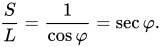
The diagram is greatly exaggerated, because in reality, S = 390 L, and φ is extremely close to 90°. Aristarchus determined φ to be a thirtieth of a quadrant (in modern terms, 3°) less than a right angle: in current terminology, 87°. Trigonometric functions had non yet been invented, but using geometrical analysis in the style of Euclid, Aristarchus determined that
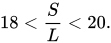
In other words, the distance to the Sunday was somewhere between 18 and 20 times greater than the distance to the Moon. This value (or values close to information technology) was accepted by astronomers for the adjacent two 1000 years, until the invention of the telescope permitted a more than precise estimate of solar parallax.
Aristarchus also reasoned that as the angular size of the Sun and the Moon were the same, merely the distance to the Sun was between 18 and xx times further than the Moon, the Lord's day must therefore be 18–20 times larger.
Lunar eclipse [edit]
Aristarchus and so used another construction based on a lunar eclipse:

Past similarity of the triangles, and
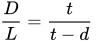
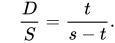
Dividing these two equations and using the observation that the credible sizes of the Sun and Moon are the same, , yields


The rightmost equation tin either exist solved for ℓ/t
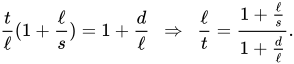
or due south/t
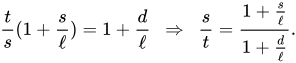
The appearance of these equations tin be simplified using due north = d/ℓ and x = due south/ℓ.
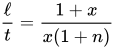

The above equations give the radii of the Moon and Sun entirely in terms of observable quantities.
The post-obit formulae give the distances to the Lord's day and Moon in terrestrial units:
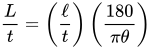
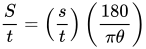
where θ is the credible radius of the Moon and Sun measured in degrees.
Information technology is unlikely that Aristarchus used these exact formulae, still these formulae are likely a good approximation for those of Aristarchus.
Results [edit]
The above formulae can be used to reconstruct the results of Aristarchus. The post-obit table shows the results of a long-continuing (merely dubious) reconstruction using north = two, x = 19.1 (φ = 87°) and θ = one°, alongside the modern day accustomed values.
| Quantity | Relation | Reconstruction | Modern |
|---|---|---|---|
| s/t | Sun's radius in Earth radii | 6.7 | 109 |
| t/ℓ | Earth's radius in Moon radii | 2.85 | 3.50 |
| L/t | Earth-Moon distance in Earth radii | twenty | sixty.32 |
| Due south/t | Earth-Dominicus distance in Globe radii | 380 | 23,500 |
[ citation needed ]
The error in this calculation comes primarily from the poor values for x and θ. The poor value for θ is peculiarly surprising, since Archimedes writes that Aristarchus was the outset to make up one's mind that the Sun and Moon had an apparent diameter of half a degree. This would requite a value of θ = 0.25, and a corresponding distance to the Moon of 80 World radii, a much better approximate. The disagreement of the work with Archimedes seems to be due to its taking an Aristarchus statement that the lunisolar diameter is 1/xv of a "meros" of the zodiac to mean 1/fifteen of a zodiacal sign (thirty°), unaware that the Greek word "meros" meant either "portion" or 7°1/2; and 1/15 of the latter amount is 1°/2, in agreement with Archimedes' testimony.
A similar procedure was afterwards used past Hipparchus, who estimated the mean distance to the Moon as 67 Earth radii, and Ptolemy, who took 59 Earth radii for this value.
Illustrations [edit]
Some interactive illustrations of the propositions in On Sizes can be constitute here:
- Hypothesis iv states that when the Moon appears to united states of america halved, its distance from the Sunday is and so less than a quadrant by one-thirtieth of a quadrant [that is, information technology is less than xc° by i/30th of 90° or three°, and is therefore equal to 87°] (Heath 1913:353).
- Proposition ane states that two equal spheres are comprehended by one and the same cylinder, and two unequal spheres by one and the same cone which has its vertex in the direction of the lesser sphere; and the straight line drawn through the centres of the spheres is at right angles to each of the circles in which the surface of the cylinder, or of the cone, touches the spheres (Heath 1913:354).
- Proffer 2 states that if a sphere be illuminated by a sphere greater than itself, the illuminated portion of the old sphere will be greater than a hemisphere (Heath 1913:358).
- Suggestion 3 states that the circle in the Moon which divides the dark and the bright portions is least when the cone comprehending both the Sunday and the Moon has its vertex at our center (Heath 1913:362).
- Proposition 4 states that the circle which divides the dark and the bright portions in the Moon is non perceptibly different from a great circle in the Moon (Heath 1913:365).
- Proposition 6 states that the Moon moves [in an orbit] lower than [that of] the Sun, and, when it is halved, is distant less than a quadrant from the Lord's day (Heath 1913:372).
- Proposition 7 states that the distance of the Sun from the Earth is greater than 18 times, but less than xx times, the distance of the Moon from the Earth (Heath 1913:377). In other words, the Sun is 18 to xx times further away and wider than the Moon.
- Suggestion 13 states that the straight line subtending the portion intercepted within the earth's shadow of the circumference of the circle in which the extremities of the bore of the circle dividing the nighttime and the bright portions in the Moon move is less than double of the diameter of the Moon, but has to it a ratio greater than that which 88 has to 45; and information technology is less than i/ninth part of the diameter of the Sun, but has to it a ratio greater than that which 21 has to 225. Simply information technology has to the straight line fatigued from the eye of the Sun at right angles to the axis and meeting the sides of the cone a ratio greater than that which 979 has to 10 125 (Heath 1913:394).
- Proposition xiv states that the direct line joined from the centre of the Earth to the centre of the Moon has to the directly line cut off from the axis towards the centre of the Moon by the direct line subtending the [circumference] within the World's shadow a ratio greater than that which 675 has to i (Heath 1913:400).
- Proffer 15 states that the diameter of the Dominicus has to the diameter of the Earth a ratio greater than xix/3, but less than 43/six (Heath 1913:403). This means that the Sun is (a mean of) 6¾ times wider than the Globe, or that the Sunday is 13½ Earth-radii wide. The Moon and Sunday must and so exist xx¼ and 387 Earth-radii away from the states in society to subtend an angular size of 2º.
- Suggestion 17a in al-Tusi's medieval Arabic version of the volume On Sizes states that the ratio of the distance of the vertex of the shadow cone from the center of the Moon (when the Moon is on the axis [that is, at the centre of an eclipse] of the cone containing the Earth and the Sun) to the altitude of the middle of the Moon from the heart of the Earth is greater than the ratio 71 to 37 and less than the ratio 3 to one (Berggren & Sidoli 2007:218).[5] In other words, that the tip of the World's shadow cone is betwixt 108/37 and four times farther abroad than the Moon.
Known copies [edit]
- Library of Congress Vatican Exhibit.
See also [edit]
- Aristarchus of Samos
- Eratosthenes (c. 276 – c. 194/195 BC), a Greek mathematician who calculated the circumference of the Earth and also the distance from the Earth to the Sun.
- Hipparchus (c. 190 – c. 120 BC), a Greek mathematician who measured the radii of the Dominicus and the Moon as well as their distances from the Earth.
- On the Sizes and Distances (Hipparchus)
- Posidonius (c. 135 – c. 51 BC), a Greek astronomer and mathematician who calculated the circumference of the Earth.
Notes [edit]
- ^ Heath, Thomas (1913). Aristarchus of Samos, the Ancient Copernicus. Oxford: Clarendon. p. 323.
- ^ Berggren and Sidoli. 2007. 'Aristarchus'due south On the Sizes and Distances of the Sun and the Moon: Greek and Arabic Texts'. Arch. Hist. Verbal Sci. 61(three), pp. 213–54. doi:10.1007/s00407-006-0118-iv
- ^ Noack B. (1992) Aristarch von Samos: Untersuchungen zur Überlieferungsgeschichte der Schrif Περὶ μεγεθῶν καὶ ἀποστημάτων ἡλίου καὶ σελήνης, Wiesbaden.
- ^ A video on reconstruction of Aristarchus' method (in Turkish, no subtitles)
- ^ Berggren, J. L. & N. Sidoli (2007) "'Aristarchus'south On the Sizes and Distances of the Sun and the Moon: Greek and Arabic Texts', Archive for History of Exact Sciences, Vol. 61, no. 3, 213–254" (PDF). Archived from the original on Apr 28, 2011. Retrieved 2011-11-07 .
{{cite web}}: CS1 maint: bot: original URL status unknown (link).
Bibliography [edit]
- Heath, Thomas (1913). Aristarchus of Samos, the Ancient Copernicus. Oxford: Clarendon. This was subsequently reprinted, see (ISBN 0-486-43886-4).
- van Helden, A. Measuring the Universe: Cosmic Dimensions from Aristarchus to Halley. Chicago: Univ. of Chicago Pr., 1985. ISBN 0-226-84882-5.
floresdegiverthe78.blogspot.com
Source: https://en.wikipedia.org/wiki/On_the_Sizes_and_Distances_%28Aristarchus%29
0 Response to "Ideal Size for Uploading Half Page Moo"
Post a Comment